

History of the Finnish Seamen’s Church
The Finnish Seamen’s Church was founded in 1875. It operated as an association for 150 years before becoming a foundation on October 1, 2025. The Church was originally established to support Finnish seafarers abroad, but fairly quickly its services were also used by migrants and other travelers.
Beginning
The Finnish Seamen’s Church was first mentioned at the Finnish Evangelical Lutheran Mission’s annual celebration in 1874. The Imperial Senate approved the statutes of the organization as an association the following year, on June 22. The founding meeting of the association was held in Helsinki at the eastern side chapel of Nikolai Church, now the Cathedral, on September 30, 1875.
In the 19th century, developments in industry, commerce, and shipping led to increased migration, growing cities, and broader societal changes. Shipping expanded, became more international, and transformed in nature, accelerated by the rise of steamships in the 1860s.
As shipping and the number of seafarers continued to grow, social, financial, and language-related problems began to emerge among seamen.
The establishment of the association was significantly influenced by contacts from the Norwegian seamen’s chaplain Johan Cordt Harmens Storjohann to the Finnish Evangelical Lutheran Mission, in which he appealed for assistance for Finnish-speaking seafarers who lacked language skills abroad.
In its early years, the Seamen’s Church was called someting like “Association for Providing Pastoral Care to Finnish Seamen in Foreign Ports”.
To launch its work, raise awareness of the society, and collect funds, a network of agents was established. Agents across the country distributed circulars and collection lists and recruited members. Through them, the association was able to publish news and articles about the seafaring profession and seamen’s mission in nearly all newspapers across Finland.
In addition to the agents, traveling preacher work was initiated, in which pastors visited parishes throughout the country to promote the society’s work.
Income from membership and support fees became, in the early years, the society’s main source of revenue after collections and sewing circles. The support of sewing circles (now Seamen’s Church districts) remained significant into the following century.
From England to the Rest of Europe
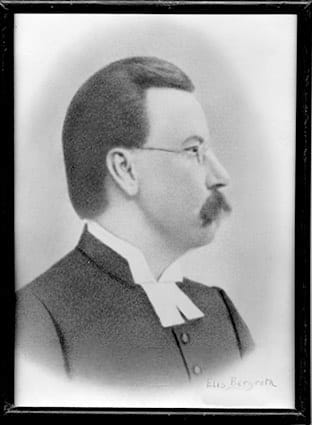
The first Finnish seamen’s chaplain was 25-year-old assistant pastor Elis Bergroth from Porvoo Cathedral, who began his work in April 1880 in Grimsby. His base was the Nordic Seamen’s Church in Grimsby, built in 1875. From Grimsby, Bergroth made work trips to Hull, Liverpool, Goole, and London.
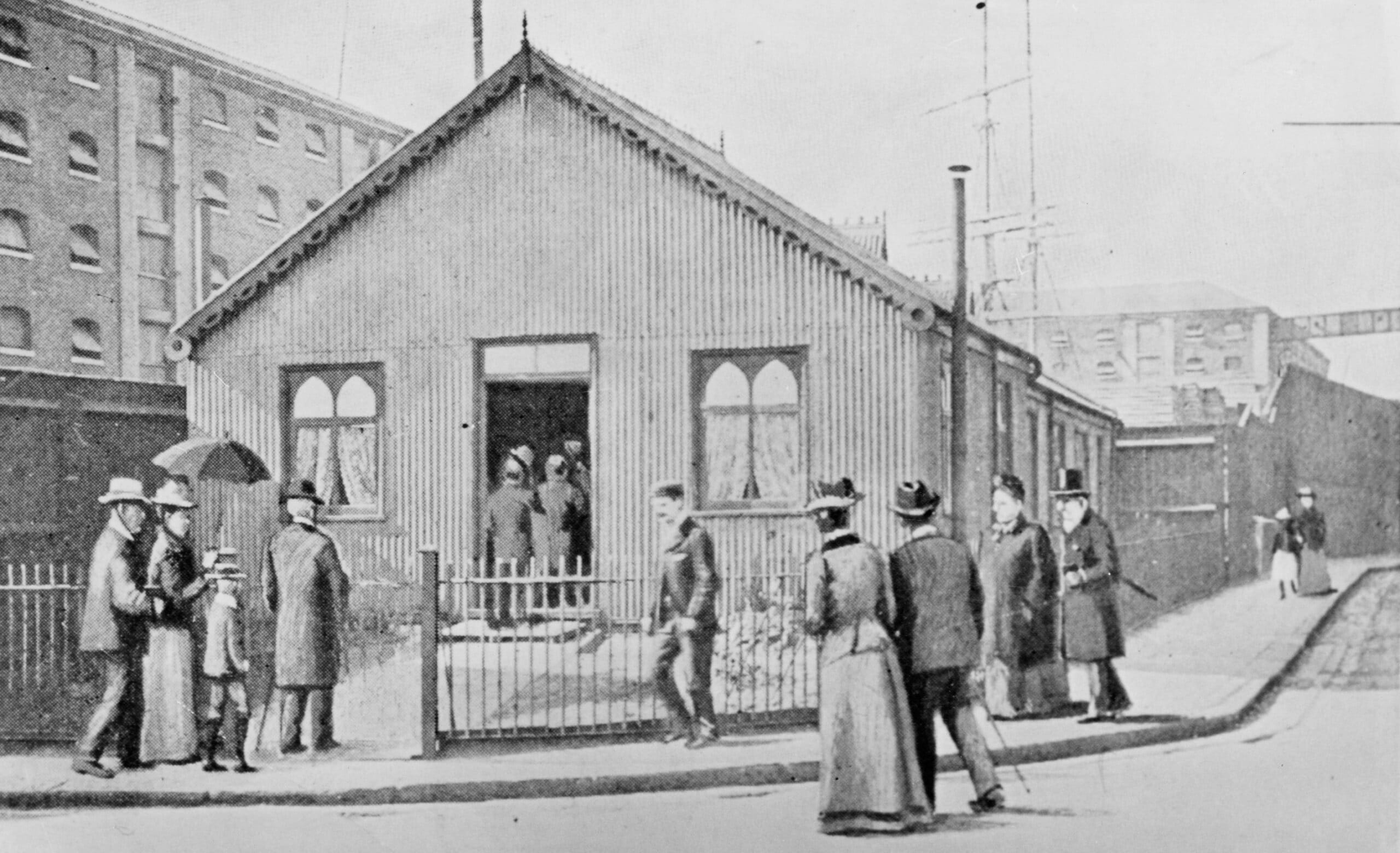
After returning to Finland in the summer of 1882 from a nearly year-long preaching tour, Bergroth settled in London at the Swedish church. The following year, a second seamen’s chaplain started work in England (Grimsby and Hull). The first Finnish Seamen’s Church building was constructed in London in 1894, and a second in Hull in 1887, where a reading room had already existed since 1884.
Initially, Finnish seamen’s mission work focused on England. From the late 1880s onward, the work expanded to other parts of Europe and North America. The third location (1886) was a year-long trial in Bordeaux, France.
Work Becomes Established and Expand
The society’s activities quickly took the forms that are still familiar today. Chaplains visited ships, hospitals, and prisons to meet Finns. Café services were started, and opportunities for sauna bathing were organized.
Libraries were established in the reading rooms of the Church’s premises, offering Finnish newspapers as well. Newspapers and books were also delivered to ships. In addition to worship services and devotions held in the reading rooms, devotional moments were also conducted on board ships.
The Seamen’s Church also began assisting seafarers with financial matters, correspondence, and notifying relatives in the event of deaths.
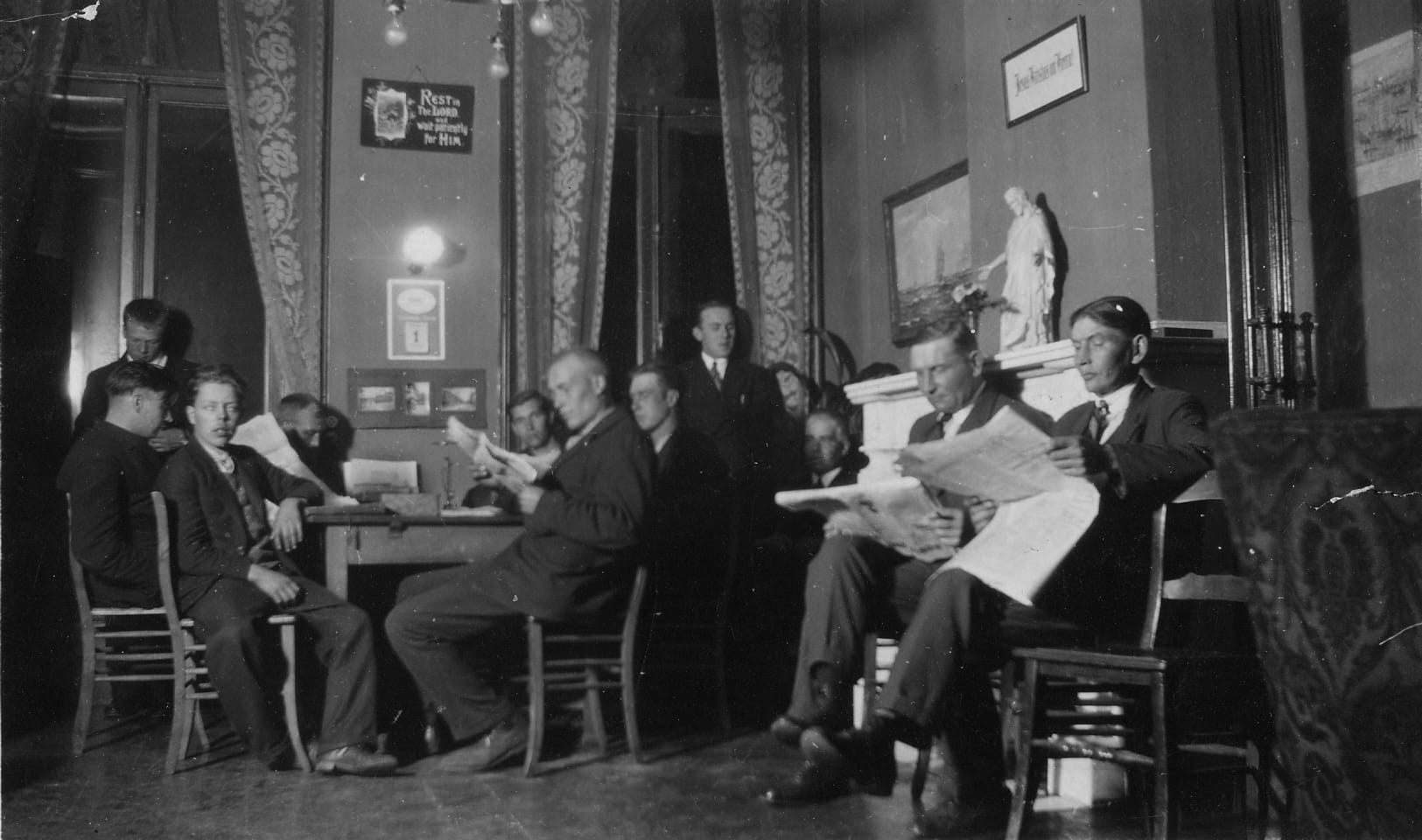
In addition to seafarers, all these services were also used by migrants and other travelers. The challenges faced by seafarers and migrants were similar: lack of language skills, poverty, uncertainty about the future, feelings of disconnection, longing for Finland, and a shared language, culture, and religion.
In North America, in New York, the first Finnish seamen’s chaplain began work in July 1887.
In 1888, the association’s name was changed to “The Finnish Seamen’s Mission Society”.
Ten years later, in 1898, a clause was added to the society’s statutes officially making migrant ministry part of its work. In 1916, the Seamen’s Mission Society began operations in Australia, and later, in the 1950s, in South America as well.
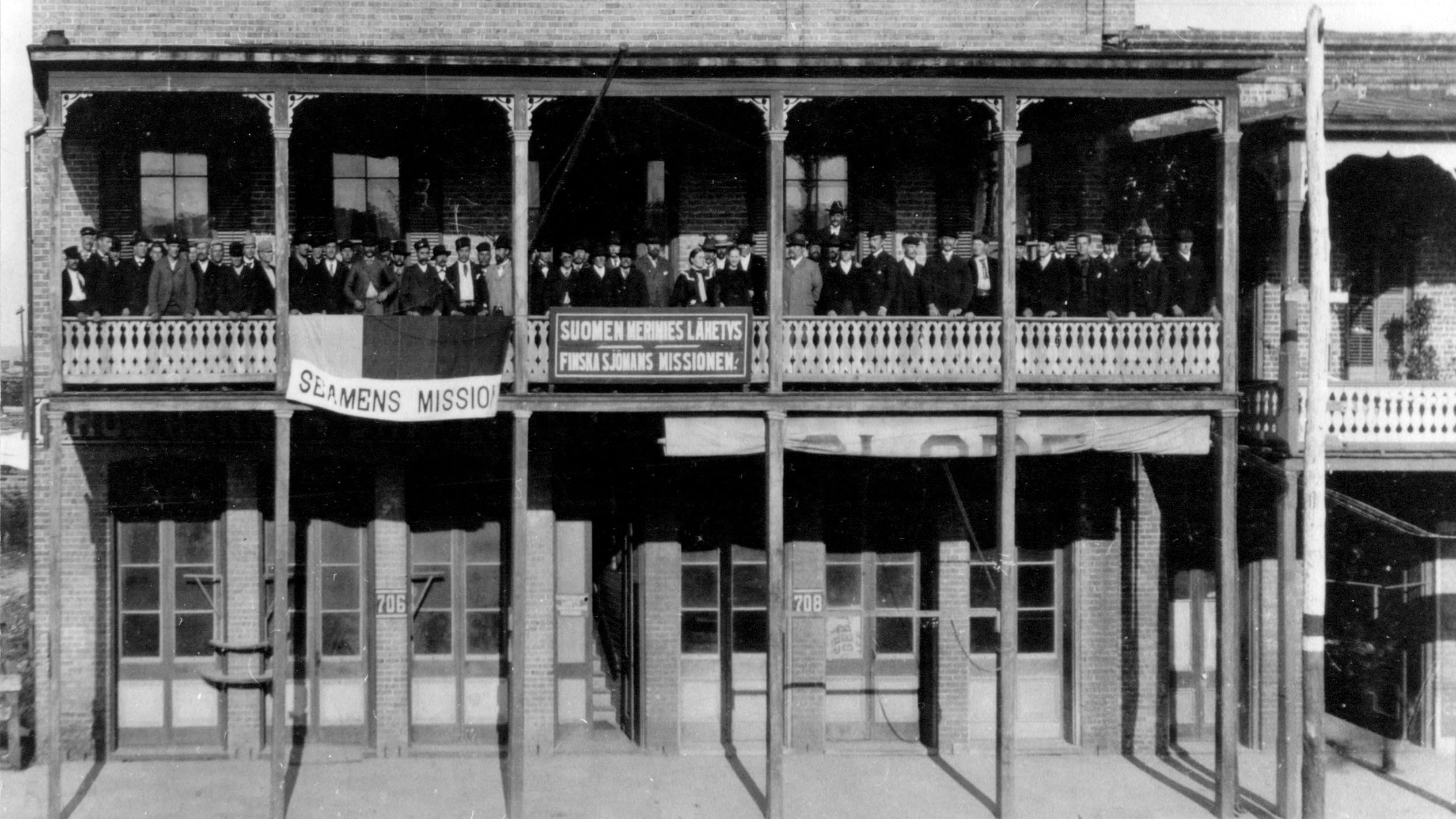
Work Begins in Finland
At the beginning of the 20th century, the work of the Seamen’s Church expanded to Finnish ports, when in 1908 a clause was added to the society’s statutes allowing employees to be hired in Finland.
However, work for the benefit of seafarers in Finland had already begun in 1880 with the Turku Seamen’s Mission Association, which became the Turku City Mission in 1892. When its activity declined, the Turku Port Mission Association was established in 1909. In 1910, it joined the Finnish Seamen’s Church, acquired a reading room, and hired its own lay preacher.
Before World War I, operations had also started in Helsinki, Oulu, and Hanko.
Organization’s official name was “The Finnish Seamen’s Mission” from 1994 to October 2025.
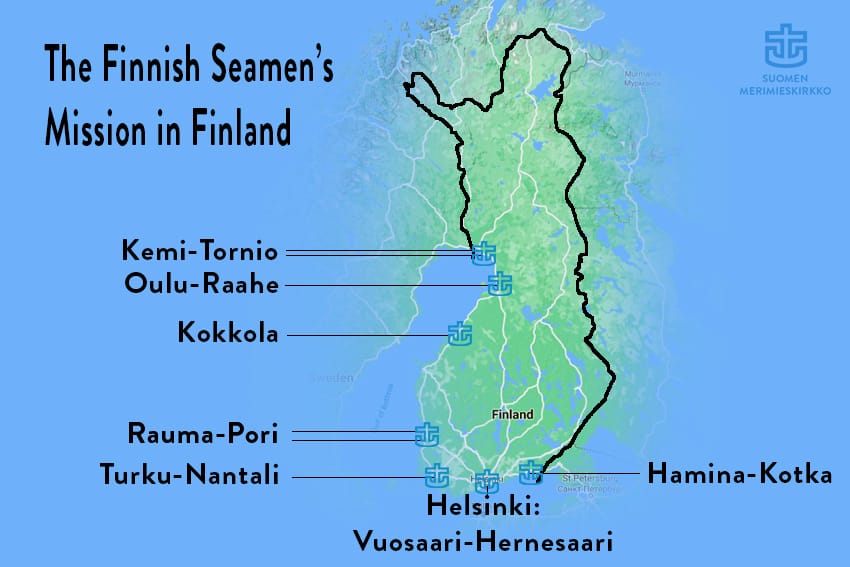
The largest customer group of the Seamen’s Churches in Finland has traditionally consisted of foreign seafarers. Currently, there are seven operational locations in the country. Port chaplains also serve seafarers in nearby ports within their regions.
In addition to the Finnish Seamen’s Church, the German Seamen’s Church operated in Mäntyluoto, Pori, until its activities in Finland ended in autumn 2019. Since early 2020, seafarers in the Port of Pori have been served by the port chaplain of the Rauma Seamen’s Church.
In Finland, seafarers were also served by a port church maintained by the Kalajoki parish from 2013 to 2021.
Changes in Operations from the 1960s onward
Shipping began to change from the 1960s onward. The total tonnage increased, ships became larger, but Finnish crews became smaller. New large ports were established far from city centers.
Technical solutions implemented in ports and on ships shortened unloading and loading times, meaning that crew members no longer had enough free time to visit Seamen’s Churches. As a result, staff of the Finnish Seamen’s Church began making more frequent visits to ships as needed.
At the same time, travel and international interaction increased, bringing new visitor groups to the Seamen’s Churches, from personnel on work assignments to day tourists. The situation was further transformed by Finland joining the European Union in 1995, after which operations also began in a non-port city, Brussels, in 2000.
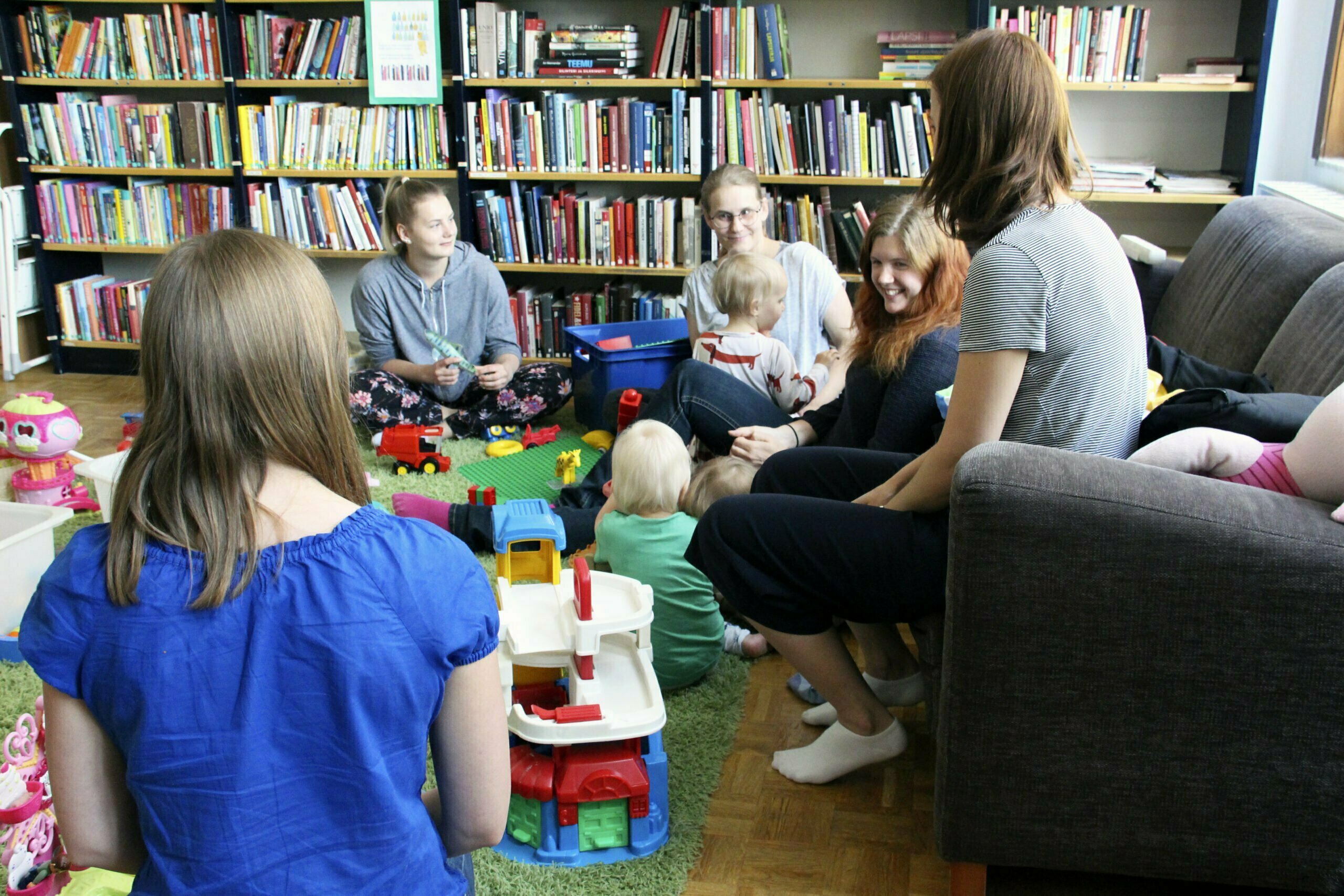
The Finnish Seamen’s Church has developed into a cultural hub and multi-purpose center promoting social well-being, serving all people on the move. The Church has also always carried out mobile outreach across its service areas. In Finland, the work focuses on seafarers, while abroad it emphasizes social work.
Staying up to date is essential for a functional and flexible Seamen’s Church. During its 150-year history, churches have been opened – and, when necessary, closed. A total of 30 Finnish Seamen’s Churches have been established abroad, of which four are currently in operation. All of these are located in Europe.
Overseas Finnish Church Work Returns to the Seamen’s Church
In 2020, the Church Council and the Finnish Seamen’s Church signed a cooperation agreement, under which operational tasks previously managed by the Church Council were to be gradually transferred to the Finnish Seamen’s Church by 2025.
In the first phase, during summer 2023, the Seamen’s Church took over church work on the Costa del Sol from the Church Council, including cooperation with the Finnish congregation on the Costa del Sol. Seasonal work in the Canary Islands, Costa Blanca, and the eastern Mediterranean was also transferred at the same time.
From the beginning of 2025, the overseas Finnish congregations previously coordinated by the Church’s overseas work – almost 40 congregations in different countries – were transferred to the Seamen’s Church.
Strategic guidelines for the work will, however, continue to be set by the Church Council. These guidelines apply only to countries that have previously been under the direct support of the Church Council.
From Association to Foundation
At the annual meeting held in spring 2025, it was decided that the Finnish Seamen’s Church would become a foundation as of October 1, 2025. The change in organizational form aims to secure the operational conditions of the Seamen’s Church, against the backdrop of a long-term decline in the number of individual members. The change did not affect operations or personnel.
The official name is in Finnish Suomen Merimieskirkko sr. At the same time, the official name in English was changed from The Finnish Seamen’s Mission to The Finnish Seamen’s Church sr. With this change, the name is now consistent with other similar organizations in the field.